Showing posts with label others. Show all posts

Sunday, 16 March 2014

2,600-Years-Old Human Brain Found in England


Archaeologists working in York in the United Kingdom discovered a remarkably well-preserved human brain that was over 2,500 years old.

Found by UK researchers, the brain was found in a decapitated skull aged 2,684 years. The brain is the oldest found brain in Europe or Asia, and is thought to be the best-preserved in the world.

The finding is particularly astonishing because, even when left on a counter in a chilled mortuary facility, brains tend to degrade quickly into liquid. This one, however, had the consistency of tofu, and had none of the distinctive smell so often associated with dead corpses.

Though it is difficult to ascertain cause of death after so many years, the damage to the neck vertebrae was consistent with a hanging. Sonia O'Connor and her colleagues believe that the person was hanged, and then the skull was decapitated.

Interestingly, the way that the body died worked against the preservation of the brain. The separation of the head from the rest of its body would have opened it up to immediate infection from bacteria.

Saturday, 15 March 2014

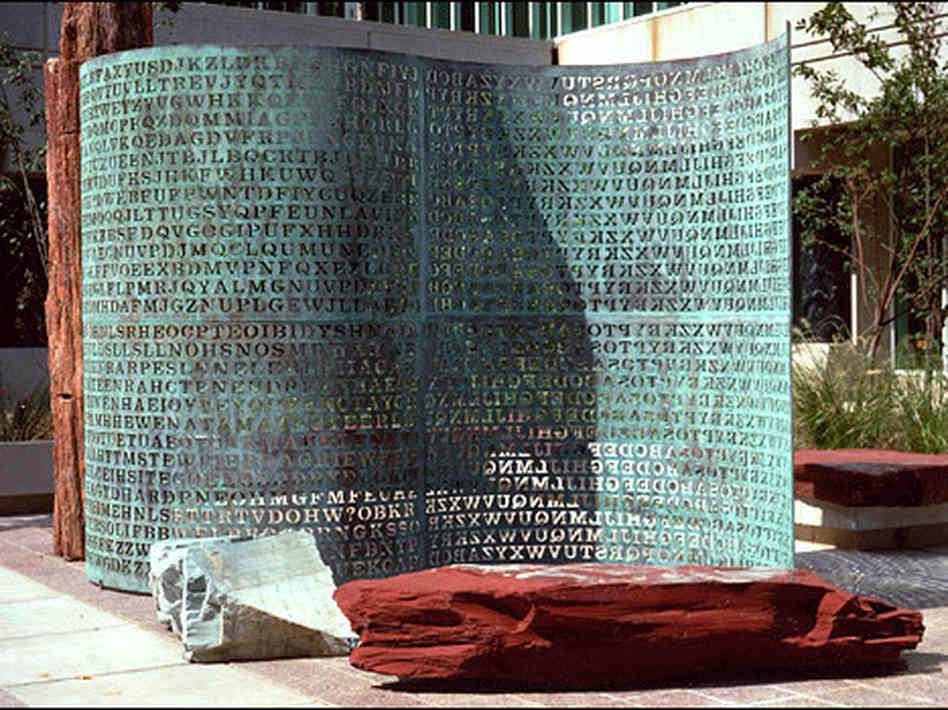
Kryptos : The Encrypted Sculpture

Kryptos,” the sculpture nestled in a courtyard of the agency’s Virginia headquarters since 1990, is a work of art with a secret code embedded in the letters that are punched into its four panels of curving copper.

It sits just steps away from some of the most brilliant cryptographers in the country, and yet after nearly 20
James Sanborn
years of trying no one has been able to unlock its secrets. OBJET D’ART In the late 1980’s, the General Services Administration, the federal agency responsible for building and operating government buildings, started accepting proposals for artwork to decorate a courtyard outside the cafeteria of the CIA’s new headquarters building in Langley, Virginia. One artist who submitted was James Sanborn, a sculptor from the Washington, D.C. area. Sanborn was struck by how CIA agents spend their entire lives keeping secrets from even their closest loved ones. He decided to put himself in their shoes: His sculpture, if accepted, would contain an encoded message- the CIA’s stock-in-trade—and only he’s take the secret with him to the grave, just like a CIA agent

Sanborn pitches his concept to the GSA and won the commission. But he’s an artist, not a code expert, so he asked the CIA for assistance in coming up with a code that would be difficult for even the agency’s own cryptographers to crack. They put him in touch with Ed Scheidt, chairman of the CIA’s Cryptographic Center, and known within the agency as the “Wizard of Codes.” Scheidt coached Sanborn for four months—he was free to teach any technique that did not compromise the agency’s security—and then Sanborn spent two and a half years cutting 865 individual letters, plus some question marks in rows onto a giant sheet of copper that was to be the main part of the sculpture.


Aluminium Wedge of Aiud Mystery


The Aluminum Wedge of Aiud is a wedge-shaped object found two kilometers east of Aiud, Romania, on the banks of the Mures River in 1974. The object was reported to be unearthed 35 feet under sand and alongside two mastodon bones. A mastodon is an extinct large tusked mammal species. Physically, the artifact looked similar to the head of a hammer. The wedge was allegedly taken to the Archeological Institute of Cluj-Napoca to be examined, where it was found to be made of an alloy of aluminum encased in a thin layer of oxide. The alloy of the wedge is composed of 12 different elements. This artifact is considered strange because aluminum was not discovered until 1808 and not produced in quantity until 1885. Aluminium requires 1,000 degrees of heat to be made. The fact that the wedge was found in the same layer of earth as mastodon bones would make it at least 11,000 years old.

Many people have claimed that the artifact is proof that aliens visited Earth. Engineers have reported that the object resembles the foot of landing gear, not unlike the technology used on spaceships. The scientific community believes the wedge was made on earth and its purpose is not yet identified. Due to the limited amount of information that exists on the subject, the antiquity and origin of the artifact is unclear. The Aluminium Wedge of Aiud is not on display to the public and remains in an undisclosed location. However, pictures of the wedge do exist.


THE AIUD ARTIFACT FACTS

1. The aluminium wedge of Aiud (also called the object of Aiud) is a mysterious artifact of uncertain origin in the shape of a wedge, which was found at an archeological site near the Roman town of Aiud, allegedly near by a mammoth skeleton.

It is composed of 89% aluminium covered by a thick oxide layer. The thickness of this oxide layer is said to be confirmation that the object is anachronistic, at least three-hundred or four-hundred years old.

The aluminium wedge of Aiud is often cited as “proof” that aliens visited earth at earlier times, because aluminium was difficult to produce in quantity before 1825. Most scientists, however, believe that this object is a fake.

2. The Aluminium wedge of Aiud (also called object of Aiud) is a mysterious body in form of a wedge, which was found at digging works near the Roman town Aiud. It consists of 89% of aluminium, which is covered by a thick oxide layer.

The thickness of this layer is said to be so strong as it would lay over a million years in the ground. The Aluminium wedge of Aiud is often cited as “proof” that aliens visited earth at earlier times, because there were no possibilities to produce Aluminium before 1825.

Baghdad Battery


Sitting in the National Museum of Iraq is a earthenware jar about the size of a man's fist. Its existence could require history books throughout the world to be rewritten.

According to most texts the "voltic pile," or electric battery, was invented in 1800 by the Count Alassandro Volta. Volta had observed that when two dissimilar metal probes were placed against frog tissue, a weak electric current was generated. Volta discovered he could reproduce this current outside of living tissue by placing the metals in certain chemical solutions. For this, and his other work with electricity, we commemorate his name in the measurement of electric potential called the volt.

The little jar in Baghdad suggests that Volta didn't invent the battery, but reinvented it. The jar was first described by German archaeologist Wilhelm Konig in 1938. It is unclear if Konig dug the object up himself or located it within the holdings of the museum, but it is known that it was found, with several others, at a place called Khujut Rabu, just outside Baghdad.

The jars are believed to be about 2,000 years old and consist of an earthenware shell, with a stopper composed of asphalt. Sticking through the top of the stopper is an iron rod. Inside the jar the rod is surrounded by a cylinder of copper. Konig thought these things looked like electric batteries and published a paper on the subject in 1940.


World War II prevented immediate follow-up on the jars, but after hostilities ceased, an American, Willard F. M. Gray of the General Electric High Voltage Laboratory in Pittsfield, Massachusetts, built some reproductions. When filled with an electrolyte like grape juice, the devices produced about two volts.

Not all scientists accept the "electric battery" description for the jars. Some suggest that they were simply containers used to hold papyrus scrolls. The scrolls have since rotted away leaving just the jars. If they were batteries, though, who made them and what were they used for?

Khujut Rabu was a settlement of a people called the Parthians. While the Parthians were excellent fighters, they had not been noted for their technological achievements and some researchers have suggested they obtained the batteries from someone else. A few people have even suggested that this someone else was a space traveller that visited Earth during ancient times.

As romantic a notion as this is, there is nothing about the Baghdad batteries that is high-tech. All the materials used are common in origin and the manufacture was well within the ability of many of the peoples of that era. What is surprising about the jars is that somebody figured out how to put the right materials together in the right way to make a device that has a function which was not obvious. It is likely that the batteries (if that is what they are) the result of an isolated and accidental development.

What might they have been used for? German researcher Dr. Arne Eggebrecht used copies of the batteries to electroplate items (a feat recently duplicated on the show Discovery Channel show Mythbusters). The electroplating process uses a small electric current to put a thin layer of one metal (such as gold) on to the surface of another (such as silver). Eggebrecht suggests that many ancient items in museums that are thought to be gold may actually be gold-plated silver.